
Despair
“It is not despair, for despair is only for those who see the end beyond all doubt. We do not.” J.R.R. Tolkien

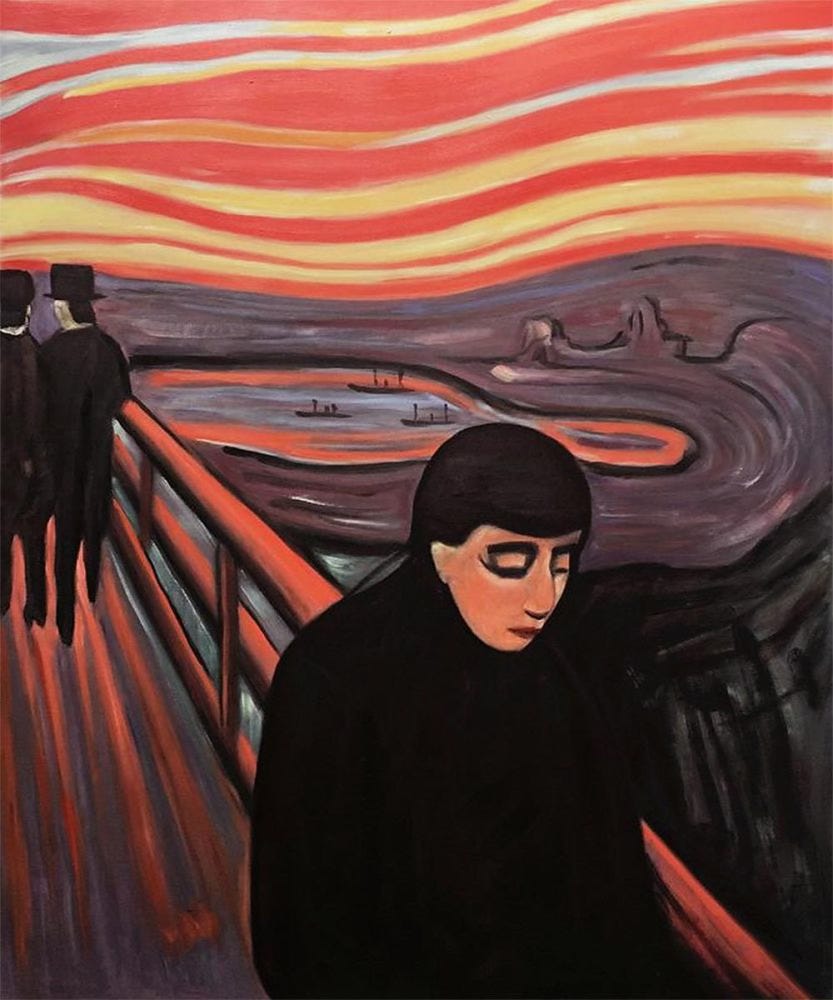
(art by Edvard Munch)
The other day, my older son and I were going somewhere in my car when he asked me, “Do you think we are going to be in a nuclear war?” His question stemmed from the worry of a post the President of the United States made stating “A whole civilization will die tonight.” Genocide of a nation that gave us poets like Rumi, Hafiz, and Omar Khayyam to name just a few. A nation that gave us great advancements in mathematics, engineering, science and architecture. It also gave me one of my favorite filmmakers, Abbas Kiarostami, who was also a poet. He once said, “Art sees things in close-up, focusing our attention, teaching us to not cast blame so freely. Art doesn't make judgements, it informs and teaches.”
“What do we do?” my son asked, the anxiety not hidden in his voice.
“All we can do,” I answered. “Hold the two tensions that are always with us: hope and despair.”
To look deeply into life is to see both of those things always there. We cannot deny our despair but nor do we have to hold only to it. Hope and despair are both born out of the same desire: that the world be a better place. As the Composer Dmitri Shostakovich said, “When a man is in despair, it means that he still believes in something.”
Despair comes from the Latin: dē- (away, off, without) + spērāre (to hope).
It’s easy to feel this sense of hopelessness when we see the continued destructiveness of man rooted in selfish greed and power. When the better nature of humanity is overshadowed by the dark desires of the few. As we watch our systems continue to be driven by the wealthy in an attempt to amass more and more. When it feels like the majority is helpless and cannot change a corrupt and broken system.
It’s easy to despair when I think of the future, especially at the thought of what might lay ahead for my possible grandchildren and their children and future generations. Yet we live in a culture that does not think in terms of generations but only the quick, instantaneous self-gratification of now.
“How do we do that?” my son asked in regard to holding the paradox of hope and despair.
“By not denying them,” I answered. “And by choosing to love. By choosing to continue to work to make one’s community better. By being kinder and compassionate even when the world is not. By taking care of those who are often unseen, forgotten, and neglected: the poor, the immigrant, the refugee, the elderly. . . Let despair be an impetus for repair for that which is broken that you can tend to within your sphere of influence.”
Gandhi said of despair, “When I despair, I remember that all through history the way of truth and love have always won. There have been tyrants and murderers, and for a time, they can seem invincible, but in the end, they always fall. Think of it - always.”
The antidote to despair is not cheering oneself up or putting on naive rose-colored glasses. It is facing the reality and choosing the activeness of hope. Hope that is a working towards a reconciliation or rebuilding of that which is broken. Of standing up against those who would lead us towards destruction, of those who seek only their own personal wealth and gain at the cost of all else, of tending to those who are not taken care of. Of seeing all as one’s neighbor, one’s bond, one’s family.
Hope is active. Not passive. It is not mere dreams but the necessary effort to strive towards change.
Hope is speaking out and up to the powers that be.
Let despair lead to compassion. Let despair lead to giving voice. Let despair lead to reaching out beyond ourselves, beyond our own needs to those of all. It is not about making ourselves greater but about making the world more equitable. Let despair lead to empathy and that empathy lead to action.
This is what I told my son.
This is what I tell myself.
It's true.
Your son is very lucky to have you as his father. Thank you for all your writings. 💕
I was very struck by the idea of holding both despair and hope in tension because they both have the same origin. I have never considered it before in quite that way.