
Destination
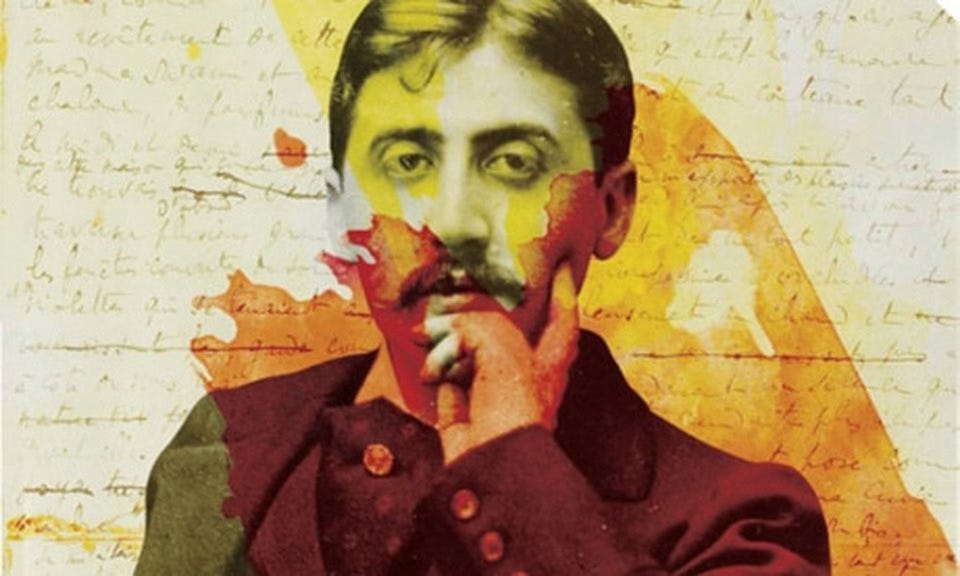
“The real voyage of discovery consists not in seeking new landscapes, but in having new eyes.” ― Marcel Proust

While brewing my coffee on this rainy, dreary morning, I gazed out at the garden. It appeared lifeless. And yet, it wasn’t. There were buds on some of the trees. The daffodils were coming up through the soil and leaves. In the midst of the daffodils bed, a Robin searched in the rain for worms. He would peck here and there for his morning meal. On a nearby branch, a bright red Cardinal stood in colorful contrast to the gray, drizzly morning. The grass was a yellowish-brown.
After I’d poured my coffee in a mug, I went into the living room and sat down on the couch. I didn’t light a candle or turn on a light but sat in the morning darkness. I sipped my coffee. I focused solely on the way it tasted, on the warmth of it on a chilly morning and I looked at the books that lined the shelves of the room I was in. So many of them had deeply shaped me in ways I had not expected on either the first, second or multiple readings. My library is constantly changing, as I sift out books that I will no longer read and keeping only those I want to return to again and again.
My eyes fell upon my copy of Marcel Proust’s In Search of Lost Time, which I found had a profound impact on me after the death of my Mother. I remember how I was still grieving her loss, when I read these words, “People do not die for us immediately, but remain bathed in a sort of aura of life which bears no relation to true immortality but through which they continue to occupy our thoughts in the same way as when they were alive. It is as though they were traveling abroad.”
Yet, on this morning, my meditations focused on something else Marcel Proust had written. “My destination,” Proust said, “is no longer a place, rather a new way of seeing.”
We too often think of destinations in relationship to our travels, especially vacations. The getting from the point of our departure to the point of our destination, is all expectation of what new things we will experience and see and explore. It is a hopeful, excited feeling. Or we think of destinations in terms of our careers or relationships or education. It is a culmination of something we are working for or towards.
I am finding myself, like Proust, shifting my idea of destination from a place to a new way of seeing. My destination is not a physical place but the very journey itself. It’s a way of both seeing and being in the world. As in his Magnus opus, Proust understands that it has everything to do with our perception of time and of memory, neither of which is fixed.
“My destination is no longer a place, rather a new way of seeing,” is an expression of a spiritual evolution, an internal journey. For me, this means a devotion to the ordinary. Of appreciating moments like watching the Robin in the rain, drinking my coffee, sitting in silence, and listening to the sounds of the rain. It is working towards a slower, more deliberate, and observant way of living to truly appreciate the world.
I am spending less time on my phone. Instead, focusing on spending my time reading, looking at art or films, listening to music, or meditating on a poem or philosophical statement. I have been watching films by great directors like Andrei Tarkovsky or Yasujirō Ozu. The latter’s work focuses on mono no aware, which is a bittersweet awareness of the impermanence of all things - capturing the quiet beauty, sadness, and inevitability of life’s transitions within the ordinary, domestic life. I don’t pick up my phone or try to read while I’m watching a film. Nor do I listen to music while I’m reading or read while I’m listening to music. Instead, I give my attention wholly to that book, that poem, that piece of music, or that film.
“Thanks to art,” says Proust, “instead of seeing one world only, our own, we see that world multiply itself and we have at our disposal as many worlds as there are original artists, worlds more different one from the other than those which revolve in infinite space, worlds which, centuries after the extinction of the fire from which their light first emanated, whether it is called Rembrandt or Vermeer, send us still each one its special radiance.”
I find that when I am giving my prolonged attention to a piece of great art, literature, film or music the more it enriches my own life and inner self.
With a piece of music by a composer like Bach, I close my eyes and participate in active or deep listening. My attention is undivided and I listen to details like melody, harmony, rhythm, and dynamics. The term “deep listening” was given by composer Pauline Oliveros to describe a state of heightened awareness to explore the depths of sound in a composition of music. I find that this act has become a kind of sacred ritual for me.
The same can be said of reading. As Proust describes it, “Reading, unlike conversation, consists for each of us in receiving the communication of another thought while remaining alone, or in other words, while continuing to bring into play the mental powers we have in solitude and which conversation immediately puts to flight; while remaining open to inspiration, the soul still hard at its fruitful labours upon itself.” Giving oneself fully to reading, experiencing, a book is a way of what Susan Sontag asserts is a “model for self-transcendence… a way of being fully human.”
When I watch a great film or read an incredible classic or gaze on a masterpiece or listen to a symphony, I find myself transformed with a deeper sense of connection to the world because I see and experience it differently. I do so not only through my thoughts and perceptions, but those given to me by new eyes of the artist I have just spent time with.
Wow! Beautiful
More to think about. Thank you!