
How Do You Cope?
"Beauty will save the world." Fyodor Dostoevsky

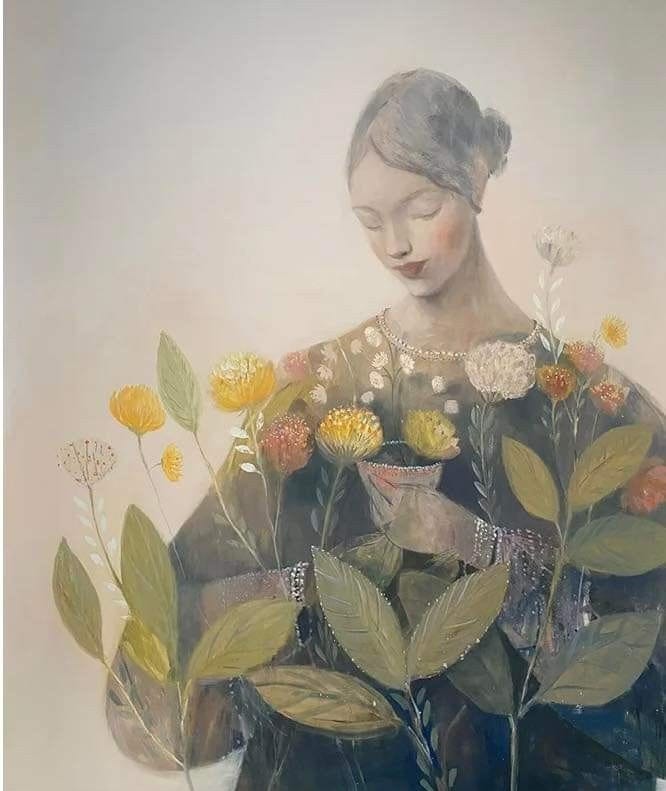
(art by Kristin Vestgard)
It is hard to be alive.
This small sentence doesn’t even seem to express how fraught and fragile the world truly is. How it has always been this way. Each new generation struggling to make sense of the senselessness of our destructive appetites and we grow closer and closer to our own annihilation.
Is it any wonder a dear friend asked me, “How do you cope?”
This is not a simple question to answer and I don’t always do it well.
Yet two quotes resonated deeply with me and I found that they were connected in their truth:
“Beauty will save the world.” Fyodor Dostoevsky
“Beauty awakens the soul to act.” Dante.
Beauty is not mere aesthetics. No, the beauty they reference challenges us, changes us, and transforms us.
The Russian filmmaker Andrei Tarkovsky believed beauty was not mere aesthetic pleasure but a profound spiritual force that counterbalance the cheap commercialism that had permeated art. He believed beauty could save the world by fostering love, sacrifice and a steadfast inner ideal that reminds humanity of its purpose and offers hope. Tarkovsky defined the purpose of art as a mean of expressing man’s “craving for the ideal.” In his brilliant book on art and cinema, Sculpting in Time, he writes, “Modern mass culture, aimed at the 'consumer', the civilisation of prosthetics, is crippling people's souls, setting up barriers between man and the crucial questions of his existence, his consciousness of himself as a spiritual being.”
His films strove for transcendence: because the world is not perfect art exists to present a kind of harmony, balance and a reminder to pay attention, to see our connection to one another and to the natural world. His father was the poet Arseny Tarkovsky, so it’s no wonder that Andrei Tarkovsky writes, “Poetry is an awareness of the world, a particular way of relating to reality.” Art at its core should “reflect the true meaning of life—love and sacrifice.”
His films, along with those of filmmakers like Terrence Malick, Yasujirō Ozu, Robert Bresson, Hirokazu Kore-eda, Hayao Miyazaki, Wim Wenders, and Clint Bentley are ones that I find myself watching with regularity these days to counterbalance the violence and ugliness, the destructiveness and crass commercialism that runs rampant. Films that remind us of why we live and why we should strive for social harmony.
As if in kinship with Tarkovsky, Estonian composer Arvo Pärt also believes that beauty is not mere window decoration but a profound spiritual force capable of redeeming a fractured world. His musical compositions, which incorporate silence, form prayers that show how music can touch the transcendent. This came out of a period of deep despair for the composer to the point where he could not write even a single note. Then, by chance or by fate, he heard Gregorian chants. As he said, “I discovered a world that I didn’t know, a world without harmony, without metre, without timbre, without instrumentation, without anything. At this moment it became clear to me which direction I had to follow, and a long journey began in my unconscious mind.” Into his compositions, he began to explore the spiritual dynamics and power of silence. “On the one hand, silence is like fertile soil, which, as it were, awaits our creative act, our seed,” Pärt says. “On the other hand, silence must be approached with a feeling of awe. And when we speak about silence, we must keep in mind that it has two different wings, so to speak. Silence can be both that which is outside of us and that which is inside a person. The silence of our soul, which isn’t even affected by external distractions, is actually more crucial but more difficult to achieve.”
Often, I turn off the radio and listen to only silence as I drive to and from work. Or, I listen to Pärt’s music which radiates from silence, from simplicity, from the sacred. Because of this, his music speaks more deeply into my spirit with a beauty that transforms me in the same way contemplation, meditation and centering prayer does. It takes me out of this world and then returns me to it more rooted, more centered in compassion and grace, less likely to break the silence with unnecessary words.
It’s as if his music steps out of chronos, or regular time, into that of kairos, or more eternal time. Simone Weil, the French philosopher and mystic, who I have returned to recently, wrote, “Everything beautiful has a mark of eternity.” Andrei Tarkovsky and Arvo Pärt would agree. They lead us from the commonplace to that space where we feel reverence, awe, and a richer love for the world because we see the interconnectedness of all things. They usher us into mystery.
Tarkovsky spoke of the awareness that comes through poetry. Poets have always spoken to that deepest part of myself ever since I first discovered Emily Dickinson as a child. Though I didn’t always understand her, I knew she was reaching for the transcendence that is a reality beyond the rigid dogmas and answers we are given by religion, politics, culture, and education. Along with Dickinson, there has always been the poet Rainer Maria Rilke. I first came across a collection of his poetry when I worked in a bookshop during university. My Mother, who had always given me a copy of Kahlil Gibran’s The Prophet, handed me her copy of Letters to a Young Poet. “He has always been a guide for me,” she said, “I think he will be for you, too.”
He has.
Rilke reminds me that beauty, wisdom and courage sustain us. That we can live in the questions and uncertainty, just as he did during the tumultuousness of the last century in which he lived. I have found both comfort and courage in his Letters to a Young Poet, Book of Hours, and Duino Elegies. This morning, in fact, I read his Ninth Elegy and was struck once more by its final lines (here translated by Joanna Macy and Anita Barrows):
See, I live. On what?
Childhood and future are equally present.
Sheer abundance of being
floods my heart.
“Sheer abundance of being floods my heart.”
Those very lines make me grateful for this life, for the beating of my heart, for the breath in my lungs. It also makes me grateful for all of life: the tensions of sorrow and joy, love and loneliness, suffering and transcendence in this time of great unraveling. When our future looks bleak in the wake of all the destruction, especially in the natural world.
Rilke reminds me to love this imperfect world just as I am to love my uncertainty, my questions, my own dying.
He teaches us to see the transcendent, the beauty and treasure it. To hold it close and to offer it to others as a gift. To be thankful that we have encountered beauty: in nature, in art, in poetry, in music, in film, in each other.
This world will bring us to tears: tears of joy, tears of sorrow. We must accept them equally. We must be thankful for both. To be aware of our own aliveness and how we are proceeding to our own dying. To be thankful for each day we are given. It’s how I approach teaching the children in my third grade classes. To remind them of the beauty of this world, that they are a part of, that they can shape and form, that they can find transcendence in.
And I walk. I have conversations with friends. I journal. I love those whom I love and allow for them to love me. I form connections. I go to therapy. I garden and I cook meals. I sit in silence and stillness.
Make every moment holy. Create small, sacred rituals that give your day meaning.
Mourn each death. Celebrate each new life.
Virginia Woolf, whose birthday was yesterday, wrote, “Absorbing, mysterious, of infinite richness, this life.”
Only when we see life, all life this way, will beauty transform and save us.
This is how I cope.
This is how I find hope.
Beauty will save the world.” Fyodor Dostoevsky
“Beauty awakens the soul to act.
I love both quotes immensely. Why? For me, recognizing beauty makes me larger. With increased capacity I CAN do what it takes to resist the dictator without fear.
What a deeply beautiful and nourishing piece, this is exactly why I’m grateful to be a subscriber. So much life, reverence, and quiet strength woven through your reflections, film, music, and poetry. The voices you highlight are among those I also return to when I need to remember what is still sacred in this world. Your writing here felt like a slow, grounding exhale… a pause to realign with wonder. Thank you for this offering.