
Wondering With Saint Augustine
"Stuff your eyes with wonder." Ray Bradbury

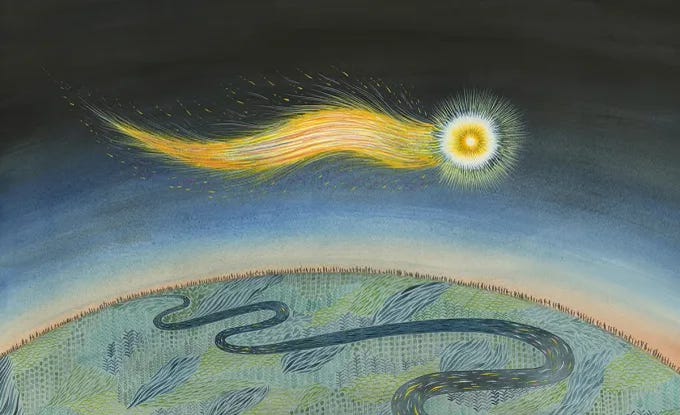
(art by Sophie Blackall)
Once a week in my third grade classroom, as part of our morning meeting, I ask if any of them have an “I wonder…"?” question. It can be about anything and I have been asked everything from “How long would it take to travel from Earth to leave the Milky Way Galaxy” to “Who invented math?” to “How are stuffed animals made?”
After one student asks their question, I open it up to the class so that they can offer their answers to the question. It is only when a few of them have given their answer, that we look it up online. This has become one of their favorite parts of the week.
We have talked about wisdom begins in wonder, which is born from curiosity. As a teacher, my main goal is to spark their sense of curiosity: about the world, about themselves, about the universe. I want them to, as Ray Bradbury said, “Stuff your eyes with wonder.”
Curiosity leads to wonder and a true sense of wonder leads what Saint Augustine coined as “Amor Mundi (love of the world).” Augustine wrote that love “is a kind of motivation, and all motion is moving towards something.” For me, if I can get a child to have a sense of wonder about the world about and within them, then they will have a desire to love and protect this precious world. As Rachel Carson understood when she wrote, “The more clearly we can focus our attention on the wonders and realities of the universe about us, the less taste we shall have for destruction.”
Contemplate the beauty and wonder of it all for contemplation is, above all, a way of seeing. Yet how often do we marvel at the wonder of our outer world without so much as a glance at the wonder of our own inner one?
In his Confessions, Saint Augustine wrote:
Men go forth to wonder at the heights of
mountains, the huge waves of the sea,
the broad flow of the rivers, the vast
compass of the ocean, the courses of the
stars: and they pass by themselves
without wondering.
I have always been a rather inward person. As a child, I was prone to introspection and to questioning as a way of understanding. Often I found my questions unwelcome, often because the adult was unable to satisfactorily answer them and was afraid to respond honestly with, “I don’t know.” It’s why, from a young age, I dislike school and Sunday school. It’s also why I began to stop asking questions to adults and to search for answers in books, especially the set of Encyclopedia Britannica my parents invested in. I used to pore over them with the same intensity I would a dictionary, seeking and soaking up every bit of knowledge and answers that I could.
It’s why I checked out armloads of books from our public library since we didn’t have a lot of books in our home. All of this was a way of connecting and understanding, a way of diving deeper into the beautiful beguiling mystery of life. The older I got, the more my questions became focused on, “Why are we here?” or “What is the purpose of life?”
